Coverage over novelty
We help clinics, campaigns and ministries reach the people they already intend to serve.
Palaver
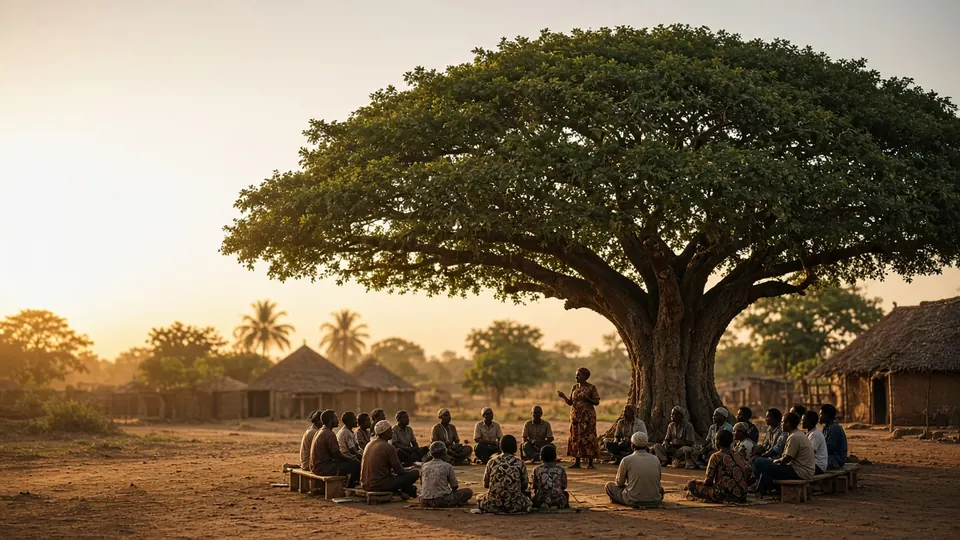
Palaver is named for the palaver tree: the place where a community gathers to talk, listen and decide together.
The name
Across West and Central African societies, the palaver tree is where people deliberate. Disputes are aired, decisions are made, and everyone in the circle can speak and be understood.
That's the promise of Palaver: to bring the circle under the tree to the systems that shape people's lives, so a clinic, a ministry or a bank can listen in the language people actually speak.
Our worldview
Language is not a feature layered on top of systems. It is the prerequisite for systems to function.
Before markets clear, before institutions coordinate, before technology scales, people must share meaning. When mutual understanding exists, trust becomes possible, coordination becomes possible, and prosperity becomes possible.
The story of the Tower of Babel describes builders who lose the work not because they lose skill, but because they can no longer understand each other. The scattering is linguistic before it is geographic.
Our thesis is direct: restore people's ability to understand and be understood in the languages they actually speak, and better health, governance, commerce and education follow.

Why Africa, why now
By 2050, about one in four people on Earth will be African. Systems that can't work in their languages will be incomplete by design.
Palaver starts in Cameroon, home to roughly 250–275 living languages from several language families within one country, where English and French are already used in formal education. It's the place to prove the hardest version of the problem first.
The road ahead
Palaver is built in phases: proof first, then reach, then a platform, then infrastructure. Each phase stands on the language layer the last one laid down.
Cameroon
Start where linguistic diversity is greatest: record bilingual speakers across an initial 50 languages, train speech-to-speech models and pilot a voice-first health application with an institutional partner.
Institutions
Turn documented results into a content engine that renders one message as localized audio and video across hundreds of languages, plus coverage reporting for ministries and NGOs.
500+ languages
Reach 500+ languages at production quality. Add consumer voice features, government communication tools and real-time cross-border voice translation for trade.
The default interface
Palaver becomes the language interface for much of the continent, with ambient earpieces and voice-first banking, payments and identity as extensions.
How we build
We help clinics, campaigns and ministries reach the people they already intend to serve.
Recording is designed with local partners and trusted teams, so the work isn't extractive.
In health and finance, the system asks for confirmation rather than acting when confidence is low.
Transparency about what the system can and can't do is part of the product.